First, Take Care of Your Own Backyard
Why responsibility starts closer to home than we like to admit.
December and January feel distinctly different to me.
December is reflective, even if it doesn’t always appear so. The days are rushed and chaotic with shopping, schedules, and end-of-year deadlines. Yet, there are moments, often later in the day, when things slow down. The house settles, noises fade, and reflection becomes possible.
You think about the year that was. What worked. What didn’t. Who mattered. What you’re grateful for. What you want to carry forward.
That’s the value of December. Not the calm, but the contrast. The pauses amidst chaos force perspective, whether you planned for them or not.
January is intentional. The pause ends, activity resumes, and focus shifts from reflection to action.
December asks, What did I learn?
January asks, What am I going to do about it?
And not long after that question, something else happens.
Our attention shifts outward. We begin to consider not only what we will do differently, but also what should change more broadly: how others should act, how systems should function, and how the world ought to behave.
This outward focus is subtle but significant, as it often occurs before we have addressed our own responsibilities.
The question then becomes not only what should change, but what should come first.
After years of reflection on personal and shared experiences, I have settled on a simple principle:
First, take care of your own backyard.
____________________________________________________________________________________________________________________________________
What I Mean by “Your Backyard”
When I say, “your backyard,” I refer to the core relationships, obligations, and situations closest to you. These are the people you interact with directly, where your choices have real impact and your actions are most apparent. Your backyard is where your influence is greatest and your engagement matters most.
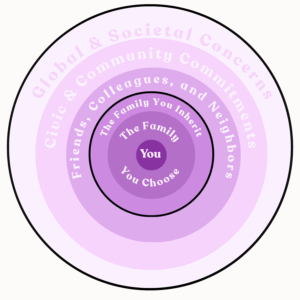
It includes you – your health, discipline, finances, and emotional steadiness. It also includes the family you choose, such as a spouse or partner, children, and commitments you knowingly opted into. Finally, it encompasses the family you inherited: parents, siblings, and relationships shaped by proximity and history.
These first three rings are “your backyard.” They are where responsibility and information are most complete, and the cost and impact of engagement are highest.
Outside of your backyard are other people’s backyards.
Neighbors, friends, communities, causes, social issues, and national or global problems also matter, but they are further from your daily life. You have less control, context, and ability to influence outcomes directly.
This distinction is important because it introduces the idea of sequence.
Responsibility is most effective when it begins where your capability is strongest and expands outward. As capacity grows, your reach can grow. But when reach expands before capacity, responsibility becomes distorted.
The closer you are to the center, the greater the obligation, control, and personal cost. The farther out, the weaker these become.
That doesn’t make the outer rings unimportant. It means they come later.
That’s what “first, take care of your own backyard” is really getting at.
Start where responsibility is clearest. Build capacity there. Then expand outward as far as your ability allows.
____________________________________________________________________________________________________________________________________
The First Ring: You
The first responsibility is straightforward, though not always easy.
Take care of yourself well enough that you are not a burden on others.
Health, discipline, finances, emotional steadiness, and character all belong here. This ring is where your control is greatest and the work is most personal and least visible.
If you are capable of taking care of yourself but choose not to, the costs do not disappear; they shift to someone else.
This matters because resources are finite. Time, money, attention, and emotional energy are always allocated somewhere. When capable people draw on support they don’t truly need, they reduce what is available for those who genuinely cannot support themselves.
Some people, through no fault of their own, are not capable of being self-sufficient. When unnecessary dependence crowds them out, the system does not just strain; it fails those it was meant to protect.
That’s why this first ring matters so much. It’s not about self-reliance as a virtue. It’s about stewardship of shared capacity.
For those who are capable of becoming stronger, steadier, and more self-sufficient, there is a responsibility to do so. Capability and responsibility grow together.
____________________________________________________________________________________________________________________________________
The Second Ring: The Family You Choose
Once you can take care of yourself without relying on others, responsibility expands outward.
The second ring is the family you choose.
A spouse or partner. Children. Long-term commitments you opted into knowingly and willingly.
This ring differs from the first in an important way. These responsibilities were not accidental; they were chosen. Because of this, there is a stronger expectation that you will show up consistently and reliably.
Taking care of yourself is essential because it enables you to care for others. Each reinforces the other.
For most people, this ring represents the largest and most sustained responsibility they will ever carry. It requires time, money, emotional energy, patience, and sacrifice over long periods. It also requires presence, not just provision.
If the first responsibility is not becoming a burden, the second is not abandoning those who depend on you by choice.
For those whose capability extends this far, this ring is not optional; it is foundational. When handled well, it stabilizes everything that follows.
This is where responsibility stops being theoretical and becomes daily, practical, and real.
Beyond this point, the waters get murkier.
____________________________________________________________________________________________________________________________________
The Third Ring: The Family You Inherited
Beyond the family you choose is the family you inherited.
Parents. Siblings. Relationships shaped by history and proximity rather than choice.
Responsibility here is less clear but still present.
Reasonable people may disagree about how much responsibility exists here, how long it should last, or what form it should take. But it’s difficult to argue that it’s zero.
There is an expectation to contribute in some way, ideally according to your capabilities.
And this is where real life complicates theory.
You try to help, but a parent refuses assistance even as health declines.
A sibling struggles with addiction, can’t hold a job, and blames everyone else.
A family member repeatedly makes choices that create chaos for those around them.
These situations do not resolve themselves. They require patience, boundaries, money, time, and emotional endurance. They are uncomfortable, often thankless, and rarely feel efficient.
This is where many people hesitate, stall, or quietly disengage.
This hesitation is understandable. However, when those capable of helping choose not to, the responsibility doesn’t vanish. The problem is pushed outward. What should have been managed close to home is handed off to others, institutions, or systems with no real connection or obligation.
The burden doesn’t go away.
It just ends up on the wrong shoulders.
____________________________________________________________________________________________________________________________________
Beyond the Inner Rings (Someone Else’s Backyard)
Once your own backyard is being handled, responsibility can extend outward.
Beyond the family you inherited are the outer rings. Friends. Neighbors. Colleagues. Community groups. Causes you care about. Broader social, national, and global issues.
These outer rings can also be thought of as someone else’s backyard.
The difference is not that the problems there are bigger or more complex. Often, the opposite is true. Problems close to home are usually harder because they persist. You live with them and carry them every day. There is no opting out, no clean exit, and no pause button.
Work in someone else’s backyard operates differently.
Responsibilities and expectations are lower. Engagement is voluntary. You can step in and out with little consequence. Emotional involvement is lighter and personal costs are easier to manage.
That’s not a flaw. It’s simply the nature of distance.
This helps explain why so many people are drawn to the outer rings before addressing what is closer to home. The work there is easier to engage with and easier to leave. It offers a sense of contribution without the sustained weight that comes with responsibility close to home.
This does not make involvement in the outer rings wrong. For those whose inner rings are stable and whose capabilities extend further, it can be meaningful and necessary.
But the sequence still matters.
Working in someone else’s backyard only makes sense after your own is properly managed. Otherwise, the effort is not additive but substitutive. The easier work replaces the harder work, not because it is more important, but because it is less demanding.
And that distinction matters.
____________________________________________________________________________________________________________________________________
The Risk of Looking Too Far Out
When people focus on the outer rings before handling what’s closer to home, the issue usually isn’t intent. It’s substitution.
Daniel Kahneman described a cognitive bias called Substitution. When faced with a hard, emotionally demanding question, the mind quietly replaces it with an easier one, often without us noticing.
Instead of asking, “What am I capable of taking responsibility for right now?”
We answer, “What do I care about?”
Instead of, “Am I showing up where the responsibility is highest?”
We ask, “Where can I feel useful with the least resistance?”
The outer rings make this substitution easy.
Engagement there is voluntary and expectations are lower. The work is episodic rather than constant. You can participate, disengage, reengage, or walk away without lasting consequences. In contrast, responsibility in the inner rings is persistent, personal, and unavoidable.
Taking care of a struggling parent.
Holding boundaries with a sibling who keeps self-destructing.
Showing up day after day in a strained marriage.
Staying disciplined when no one is watching.
That work is difficult, emotionally draining, rarely feels efficient, and almost never comes with recognition.
So the mind looks for relief.
Outer-ring causes offer a cleaner story. The effort feels meaningful. Costs are manageable. Feedback, immediate. All of that makes it easier to believe we’re doing the right thing, even if responsibilities closer to home remain unresolved.
This is where the sequence breaks down.
When focus moves outward too early, responsibility does not disappear; it is displaced. The weight that should have been carried by the inner rings is pushed onto people farther away, often onto systems or strangers with no direct connection to the situation.
Substitution feels productive in the moment.
But over time, it leaves the most important work undone.
____________________________________________________________________________________________________________________________________
Overlapping Backyards
One of the quiet strengths of this approach is that backyards don’t exist in isolation; they overlap.
Not everyone is capable of taking care of themselves. Some people, through no fault of their own, are not able to carry that first ring fully. When this occurs, responsibility does not disappear; it shifts to those closest to them.
That’s where overlap matters.
Family backyards overlap. A parent’s capacity often extends into a child’s life, and a sibling’s steadiness can help another through a difficult season. When responsibility is managed close to home, gaps are covered naturally.
This is also why it is so important for those capable of taking care of themselves to do so. Choosing not to carry your own weight doesn’t just affect you; it draws resources away from those who genuinely need help and puts unnecessary strain on the overlapping backyards around you.
But the overlap doesn’t stop at the first few rings.
As capability grows, backyards expand. Some people have the capacity to extend beyond themselves and their immediate family, reaching friends, their community, and roles where they can help those who have no one else to rely on.
The point isn’t that everyone should do everything.
The point is that if each person took responsibility for what they are capable of carrying, starting with themselves and moving outward in the right sequence, the overlap would address the rest.
Most people wouldn’t be left behind.
Most needs would be met closer to where they belong.
Fewer burdens would be pushed onto strangers and systems never designed to replace personal responsibility.
That’s the beauty of overlapping backyards.
This is why doing what you are capable of, even if it is only taking care of yourself, matters so much.
____________________________________________________________________________________________________________________________________
Bringing It Together
The First, Take Care of Your Backyard philosophy is not about doing less.
It’s about sequence.
Responsibility should expand outward only as capability allows, not in place of what’s already yours to carry. You don’t need to fix everything or take on the world. And you don’t need to measure yourself against anyone else’s capacity.
You only need to be honest about your own.
For some, being capable means taking care of themselves well and not becoming a burden on others. If that is all you can do right now, it matters. It is enough.
For others, capability extends further – to a partner, children, aging parents, or struggling siblings. For some, it extends even further into community, causes, and broader responsibility.
None of these paths are wrong.
The mistake isn’t doing more.
The mistake is skipping what is closest to reach what is farther away.
When responsibility is managed in the right sequence, fewer problems escalate, fewer crises spill outward, and fewer burdens are pushed onto people who were never meant to carry them.
That’s the quiet power of taking care of your own backyard.
The hardest responsibilities are usually the quiet ones.
The ones that don’t come with clear wins or clean endings.
The ones that test patience more than belief.
But those are the responsibilities that shape lives.
Families. Communities. Futures.
And they always start in the same place.
In your backyard.
With appreciation,
Ed Vargo
____________________________________________________________________________________________________________________________________
Ed’s Observations is a monthly reflection on life, responsibility, and the behaviors that quietly shape our financial and personal well-being.